
Searching for a Warrant in Ward County
Ward County posts no public search that blends district, JP, and city court records. The issuing court on your ticket or case papers is the place to ask. Lost the paper? A prior notice or receipt may still show the court name. Web results can never replace that court's own current record. For a district felony, contact the Ward County District Clerk. A city ticket belongs to Monahans Municipal Court, while JP citations go to the precinct listed on them; the Sheriff's site offers only a general contact, with no public warrant unit.
- Read the issuing court and cause or citation number.
- Call that clerk and ask whether the current docket shows warrant process.
- Check the matching payment route only for the citation or balance it serves.
- If the office is unclear, ask the sheriff for routing.
- Ask a Texas attorney about next steps before appearing if arrest may be an issue.
Ward County Has No Unified Warrant Search
What Ward County actually publishes is a web of separate offices, not one warrant database. The Ward County Sheriff page gives a general contact plus a VINELink custody link, and neither one is a public list of active warrants. The county site also links to both JP offices with their citation-payment route, and the 143rd Judicial District Court maintains its own information page. That layout matters when a search comes up empty. A blank result may only mean that one channel never covered the issuing court, or that the office simply posts nothing online. Ask the clerk to check the court's own record before concluding anything. A directory of offices helps you pick a phone number, but it cannot settle a person's warrant status by itself. For its part, the Ward County Clerk's official page spells out which record types the office excludes, among them traffic tickets and felony cases, so that page can save you a wasted call.
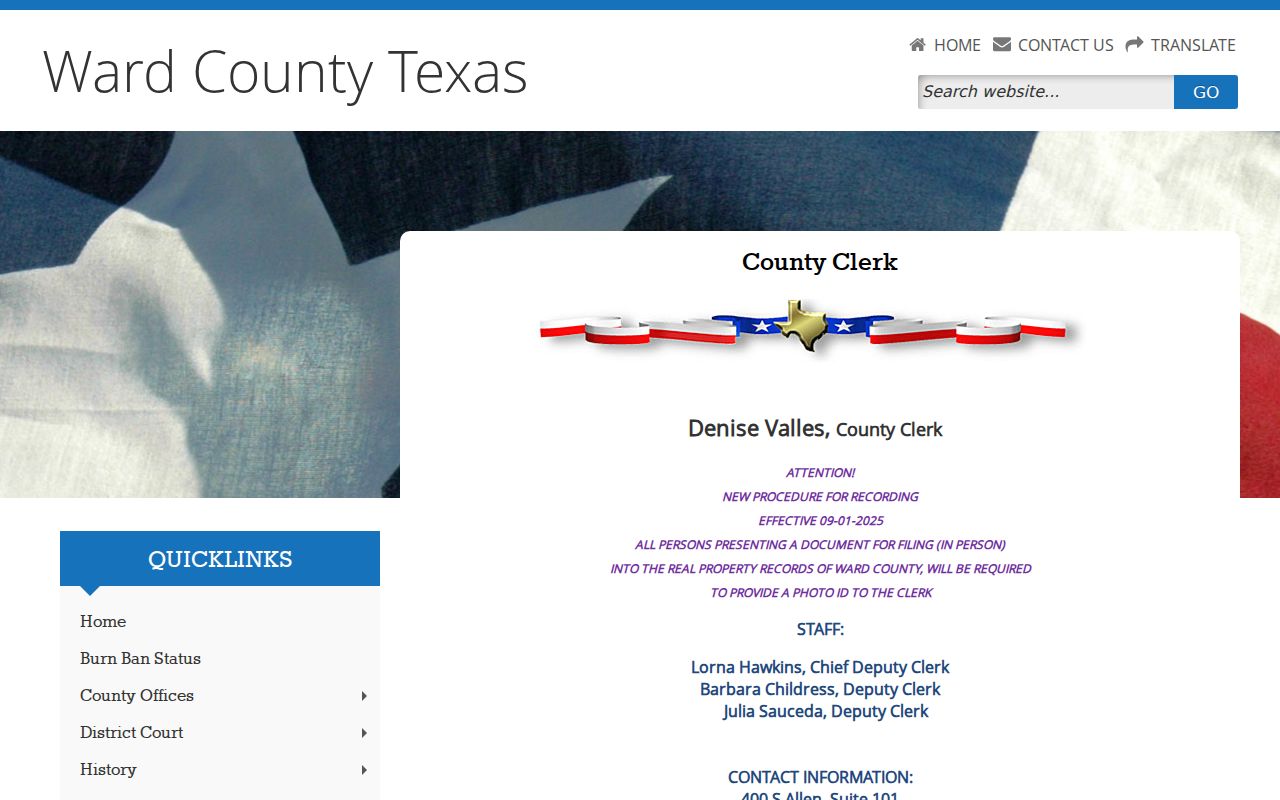
This scope check can prevent a misdirected request to the wrong clerk.
Ward County Warrant Search Fields Explained
Ward County offers no public criminal-warrant form with name or birth-date fields. So ask the court which identifier it uses; a citation or case number often does the job. Fields on a payment vendor's site say nothing about a court warrant search. When you call, share only what the court needs to locate the record. Ask what details it requires and how the answer will come back. Keep sensitive personal data away from a general county email or a third-party payment page unless the official court itself directs you there.
| Information | Use | Limit |
|---|---|---|
| Court and precinct | Routes the inquiry | Do not guess from city alone |
| Citation or cause number | Helps the clerk find the case | Payment portal may not show process |
| Case date | Separates similar matters | Ask the court what range it can search |
| Name spelling | Useful when no number is available | A name match alone is not confirmation |
GovRec Is Not a Warrant Lookup
The JP pages point to GovRec for Ward citation payments, and the county's own pages describe it as an online payment link rather than a criminal-warrant database. Treat it as a way to pay a citation. Nothing more. Before paying anything, call the issuing JP court and ask whether the citation carries a warrant, what amount is due, and whether payment alone changes the court's process, since the answer varies case by case. A payment confirmation proves a transaction happened, but it does not show that the judge recalled a warrant or that the matter cleared anywhere else. The Ward County linked GovRec page lays out its citation-payment workflow, which is exactly what that official page shows, and no person's warrant result.
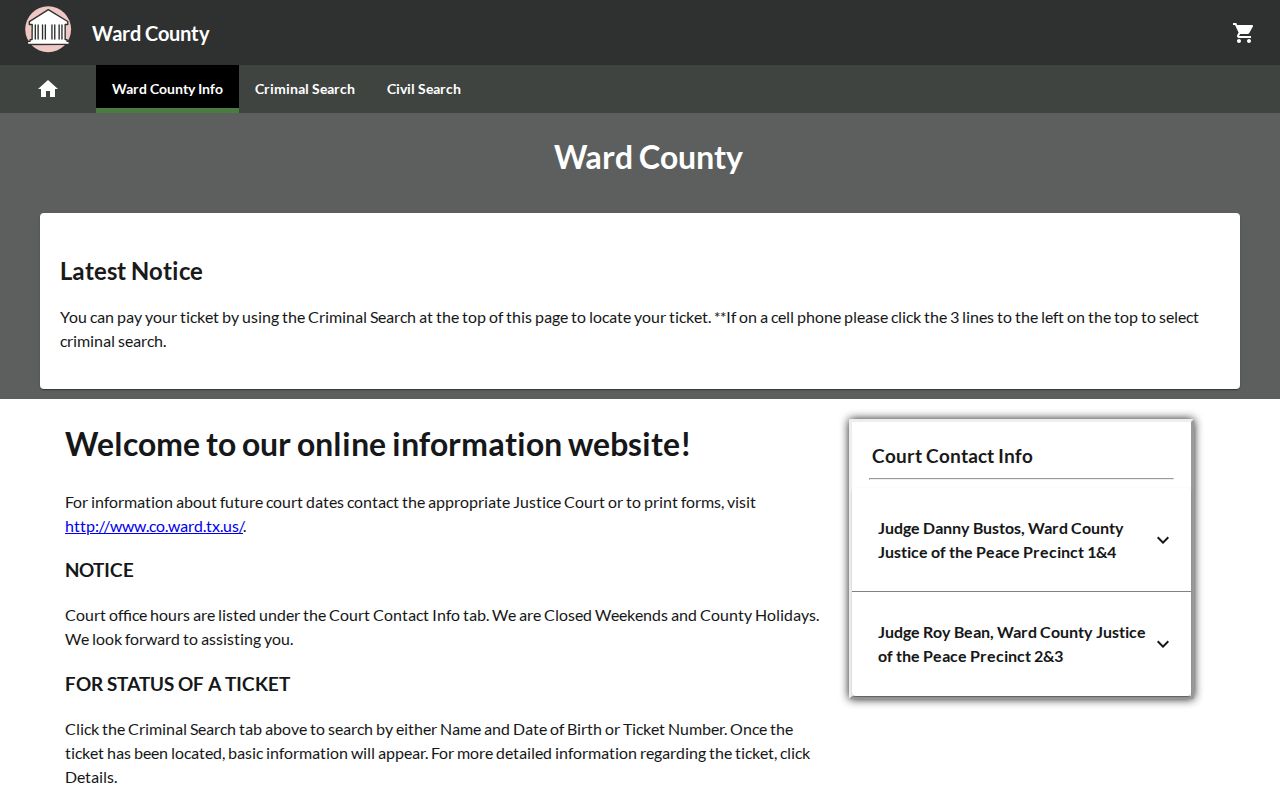
Reach the GovRec portal only through the official Ward County court link, and verify case status with the court itself.
Ward County Warrant Search Record Fields
A case record can carry a court name, process type, case number, dates, charge, bond amount, service entry, return, or a recall notation. Ward County's public pages do not display all these fields in one shared record. Ask the court which entry is current and what it means. Sealed, juvenile, or otherwise restricted records may stay closed to the public. A missing line on a payment screen is not a legal ruling about a warrant.
| Process type | Arrest warrant, bench process, capias, or capias pro fine. |
|---|---|
| Issuing authority | The court or judge tied to the case. |
| Case key | A cause number or lower-court citation number. |
| Status trail | Issue, execution, return, recall, or other docket event if releasable. |
| Terms | Bond or payment details the court has set, if any. |
Ward County Offices Hold Different Case Files
Each Ward County office keeps a different slice of the case files. The County Clerk flatly excludes traffic tickets and felony cases from its listed work. District criminal filings run through the District Clerk, JP clerks hold lower-court citation matters, and a municipal court takes its own city's Class C cases. Follow the court name on the record instead of picking an office by title. The 143rd Judicial District serves Ward, Loving, and Reeves Counties, with its Ward office at 400 S. Allen, Suite 200, in Monahans. The District Clerk's mailing address is the courthouse P.O. Box, and the office notes that some original files sit in offsite storage. Call before a long drive; retrieval usually takes about a day. For JP records, the county lists Precincts 1 and 4 and Precincts 2 and 3 on separate pages.
Where to Check Warrants in Ward County
The Sheriff routes service questions you cannot sort out; the issuing court confirms its docket. A written request can obtain an existing government record, but it is no substitute for a live status check. In Monahans, city court matters go to Municipal Court at 432-943-6361. The city page lists Class C and parking jurisdiction for that court. Federal process is a different world: Ward County sits in the Pecos Division of the Western District of Texas, which runs its own court and U.S. Marshals channels. Federal access never flows through a county search.
Ward County District Clerk
Ward County Courthouse, P.O. Box 440
Monahans, TX 79756
432-943-2751
Ward County Warrant Requests in Writing
A written request under the Texas Public Information Act is one way to seek warrant records. It works for existing, non-exempt documents held by a county or city body. Name the office you are writing to. Describe the record type, and give a sensible date range or citation reference. One thing to avoid: do not ask an agency to build a fresh Ward County warrant list that does not already exist. Courts and judicial records sit under a different access framework. The Texas Attorney General’s request guide spells out the written methods and what a request should contain. The official County Clerk page adds two cautions. Some records must be reviewed in person, and the office is not required to perform searches for you. If a warrant record belongs to another holder, ask the clerk in writing to point you there. For a live status question, though, a phone call to the issuing clerk beats a letter. Save the written request for an existing document or procedure, never for a new countywide list.
Restricted Warrants and Access Rules
Not every warrant record in Texas is public. Article 15.26 of the Code of Criminal Procedure opens access to an arrest warrant, and its supporting affidavit, once the warrant is executed, subject to the governing rule. Juvenile files add another layer. Family Code Chapter 58 can attach confidentiality protections to them. A Ward County clerk may withhold a record or hand it over with parts blacked out, but only under a specific rule. Ask which law or court rule applies. Ask whether a public portion can still come out. And remember where you file matters: send a broad request to the wrong Ward County office and it may simply be redirected to another holder. That redirect does not establish that the record does not exist.
Access rule: The Texas Public Information Act covers public information held by government bodies. Court records also follow court-specific access rules, including criminal procedure and confidentiality law.
Texas Code of Criminal Procedure, Chapter 15 and Family Code, Chapter 58 are starting points.
A Payment Result Cannot Recall Process
Paying online settles less than people assume. GovRec takes payments on JP citations. DPS and OmniBase handle the FTA/FTP license renewal block, yet neither one shows the issuing court’s warrant record. Keep every receipt. Then call the court and ask what still stands, and whether a separate action or update must follow the payment. DPS itself sends people to the issuing court for confirmation, not to a license staff line. For the fuller Ward County picture, the Ward County warrant records overview maps district, JP, city, and sheriff contacts without pretending they form one database.